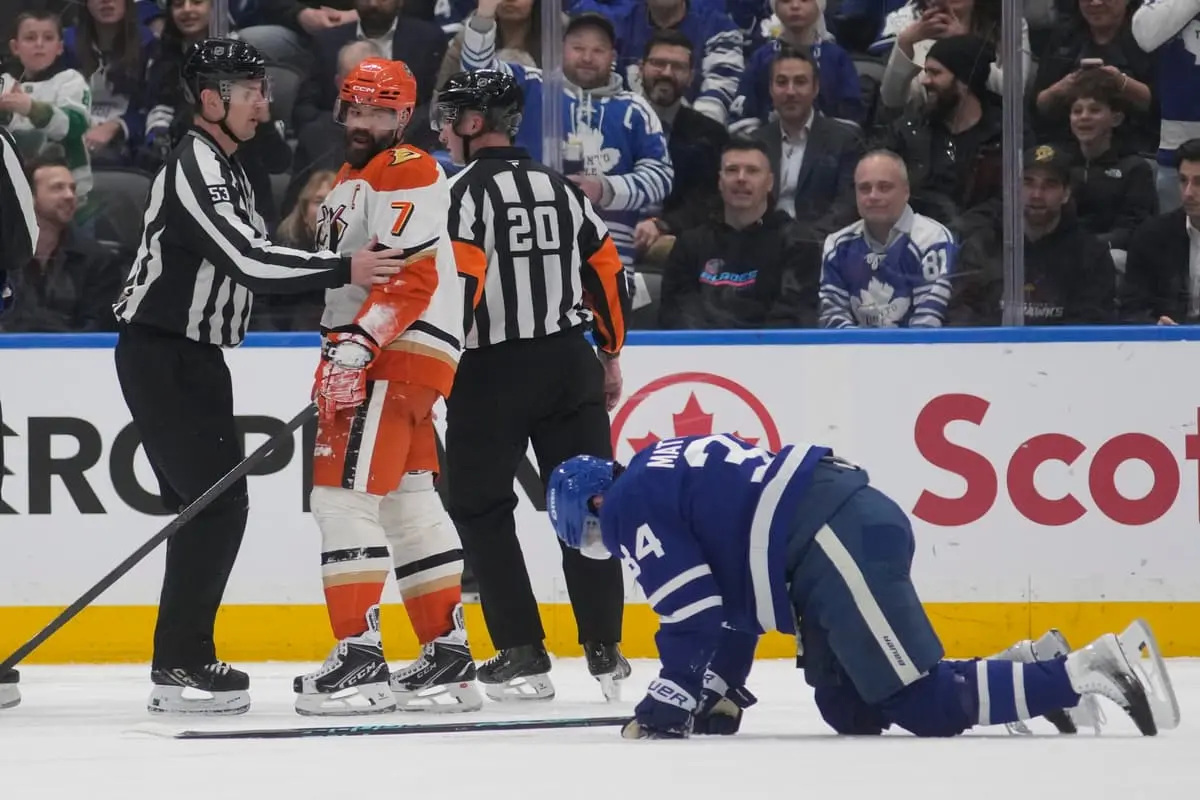
The Toronto Maple Leafs face a precarious situation following a knee-on-knee collision involving captain Auston Matthews during Thursday's game against the Anaheim Ducks. The incident, which resulted in a major penalty and game misconduct for Ducks defenceman Radko Gudas, threatens to derail not only the remainder of the 2025-26 season but potentially the team's financial planning and competitive trajectory heading into next year. With Matthews sidelined for evaluation and Gudas facing supplemental discipline, the Leafs organization must now grapple with both immediate on-ice consequences and longer-term implications for the franchise's investment in its star player.
The Collision and Immediate Aftermath
The incident unfolded during the second period of Toronto's eventual 6-4 victory over Anaheim on Thursday night. Matthews, who had just ended a 12-game goal drought—the longest stretch since his rookie season in 2016-17—appeared to be gaining momentum when he attempted to maneuver around Gudas near the Ducks' net. The collision resulted in a knee-on-knee impact that sent Matthews to the ice in visible distress.
Officials assessed a five-minute major penalty and game misconduct to Gudas, acknowledging the severity of the contact. However, the immediate concern centered not on the penalty assessment but on Matthews' ability to continue playing. After lying motionless on the ice for approximately a minute, the Leafs captain required assistance to reach the dressing room and did not return for the remainder of the contest.
Disciplinary Proceedings and Gudas' History
The NHL Department of Player Safety scheduled a telephone hearing for Gudas on Friday to review the incident. The fact that the hearing was conducted over the phone rather than in person carries significant implications: it limits any potential suspension to a maximum of five games, according to league protocols.
Gudas brings a complicated history to such proceedings. The veteran defenceman has faced supplemental discipline on three previous occasions, though his most recent infraction dated to 2019, meaning he does not carry the designation of a repeat offender under current NHL rules. However, his recent involvement in another high-profile incident adds context to the current situation. At the 2026 Olympics in Milano Cortina last month, Gudas delivered a hit that sidelined Canada's Sidney Crosby during a quarterfinal matchup between Canada and Gudas' native Czechia, though that play went unpunalized at the time.
Ducks head coach Joel Quenneville characterized the collision as a reflexive action rather than premeditated, stating there was no intentional malice in the play. This perspective may influence the league's disciplinary decision, though player safety remains the stated priority of the Department of Player Safety.
Impact on Toronto's Season and Organizational Strategy
The Leafs organization faces a particularly challenging scenario given the current state of the 2025-26 season. Toronto has already been eliminated from playoff contention, marking the first time in nine years the franchise will miss the postseason and the first such occurrence during Matthews' tenure with the club. This reality prompted management to execute a significant trade deadline selloff, moving veteran forwards Nicolas Roy, Bobby McMann, and Scott Laughton to other organizations.
The timing of Matthews' injury represents a worst-case scenario for franchise planning. While the organization had already accepted the loss of this season, the primary objective shifted toward protecting the health and development of core players for future competitive windows. An extended absence by Matthews—or worse, a long-term injury requiring offseason rehabilitation—could compromise the team's ability to contend next season when the expectation is to return to playoff contention.
Coach Craig Berube provided no definitive timeline for Matthews' status, indicating only that the player would undergo medical evaluation on Friday. This uncertainty creates complications for organizational planning, salary cap management, and roster construction decisions that typically occur during the offseason.
Team Response and Leadership Concerns
Beyond the injury itself, Berube expressed frustration with the initial response from his teammates following the collision. The coach criticized the team's failure to immediately respond to what he characterized as a dirty play, suggesting that greater physical accountability and protection of star players should have been evident on the ice.
Leafs center John Tavares acknowledged the severity of the hit, describing it as a significant collision that warranted the officials' penalty assessment. Defenseman Morgan Rielly accepted personal responsibility for not responding quickly enough to defend his captain, suggesting that defensive lapses in positioning and awareness contributed to the vulnerability that allowed the collision to occur unimpeded.
These concerns extend beyond the immediate game. In a season already marked by underperformance and organizational reset, questions about team culture, player accountability, and leadership cohesion carry weight. The Leafs organization must assess whether the current roster possesses the necessary character and commitment to protect one another during adversity.
Financial and Contractual Implications
Matthews remains among the NHL's highest-paid players, and his health status carries direct financial implications for the franchise. Extended absences due to injury could affect the team's salary cap positioning, insurance claims, and long-term financial planning. Additionally, the loss of Matthews' production—he had accumulated 27 goals and 53 points before Thursday's game—impacts the franchise's ability to generate revenue through ticket sales, merchandise, and fan engagement.
For a market like Toronto, where the Maple Leafs represent one of the most valuable sports franchises in North America, the absence of the team's marquee player carries measurable economic consequences. The organization must balance immediate financial considerations with the imperative to ensure Matthews' complete recovery and readiness for the 2026-27 season.
Looking Ahead
The Leafs organization now enters a waiting period characterized by medical uncertainty and procedural reviews. The NHL's disciplinary decision regarding Gudas will be rendered in the coming days, but the more pressing concern remains Matthews' medical status and the extent of any injury sustained during the collision.
For a franchise that has already written off the 2025-26 season, protecting the health and integrity of its core assets becomes the paramount objective. The injury to Matthews serves as a stark reminder of the physical risks inherent in professional hockey and the importance of organizational resilience during periods of transition and rebuilding.
Related Articles
- El Niño's Return Could Drive Record Global Temperatures and Reshape Financial Markets in 2027
- Jeff Kaplan's Blizzard Exit: How Overwatch League Ambitions and Financial Pressures Fractured a Gaming Empire
- Security incident at Old Dominion University raises questions about campus safety funding and institutional preparedness
The collision between Auston Matthews and Radko Gudas represents more than a single incident in an already-lost season. It crystallizes the challenges facing the Toronto Maple Leafs as they navigate a transitional year while attempting to preserve the health and readiness of their star players for future competitive windows. With Matthews facing medical evaluation and Gudas facing disciplinary review, the organization must now manage multiple uncertainties while maintaining focus on long-term organizational objectives. The coming days will provide clarity on Matthews' status, but the broader implications for the franchise's financial planning, roster management, and competitive timeline will resonate throughout the offseason and beyond.


